Module 6. The Wellespring Project: From Songs to Systems
Course 1: Singing the News. Understanding Jesse Welles and the Wellespring Project
Estimated Time: 20 minutes
🧭 Module Objectives
- Explain how the Wellespring Project grew from the study of Jesse Welles' music and cultural impact.
- Understand the basic concept of a knowledge graph and how it helps visualize cultural networks.
- Identify pathways for continued learning through future Wellespring courses and resources.
From Song to System
Welles' 2024–25 creative burst did more than revive folk protest—it created a living archive of how a single artist's voice moves through culture. The Wellespring Project emerged to study that movement systematically:
- How do themes connect across songs?
- Which people, places, and issues recur in his lyrics?
- What does his network of references reveal about contemporary American consciousness?
Our answer: by turning the art into a knowledge graph.
The Knowledge Graph in Plain Language
Imagine every song, person, place, and concept as a node and every connection between them as a line.
When we feed lyrics, interviews, and public reactions into Neo4j, we can ask visual questions like:
- Which songs mention the same concept (e.g., health, faith, war)?
- Who is referenced most often (across songs or public responses)?
- How do themes shift between eras, from Jeh Sea Wells to Welles to the folk period?
Here are some visual diagrams from our DRAFT Wellespring Project data model:
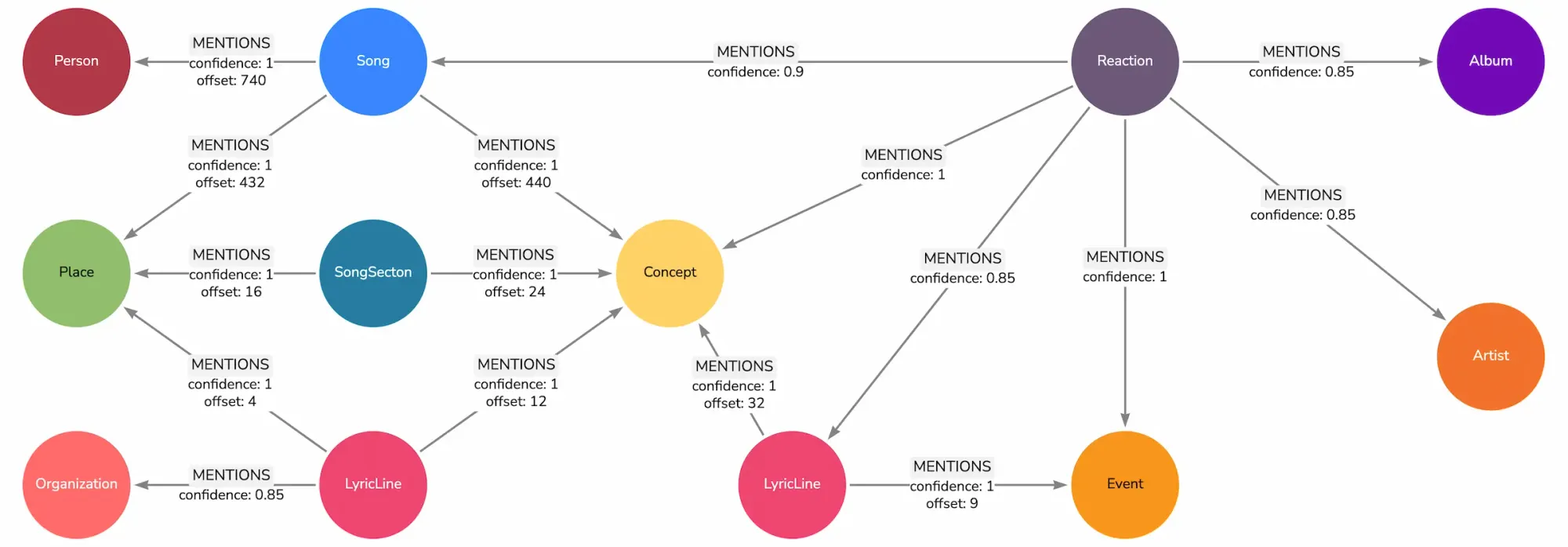
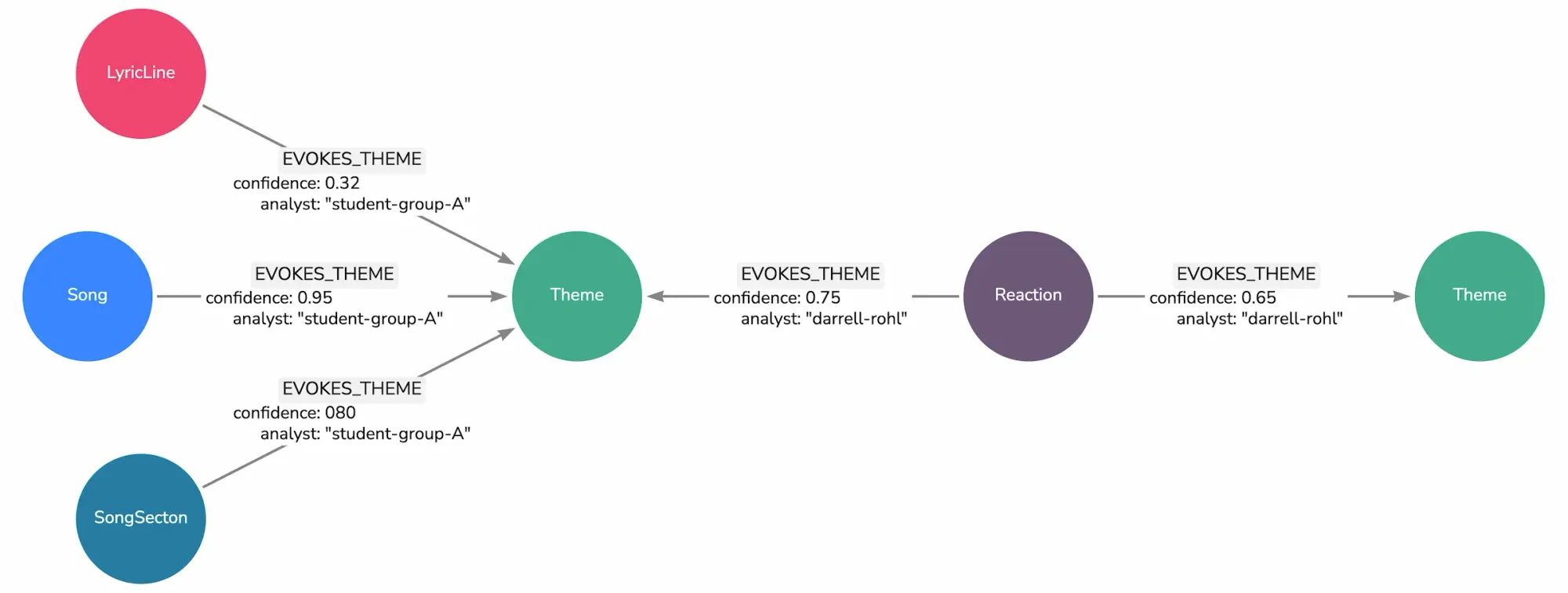
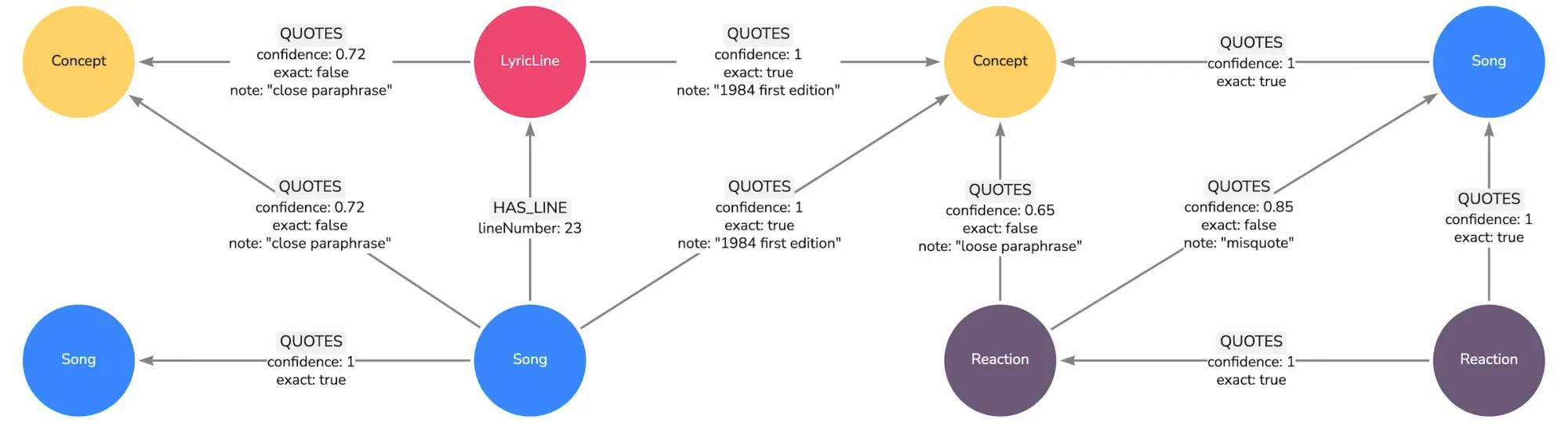
These patterns don't replace interpretation—they amplify it, making relationships visible at scale.
Humanities in the Loop
Every data point is anchored in close reading. Students and researchers contribute annotations to the database.
📝 Lyric Annotation: Mark lines that reference social issues or literary motifs.
🗣️ Reaction Mapping: Log fan comments, interviews, and press coverage.
🌍 Cultural Context: Tag places, events, and historical figures.
This fusion of qualitative and quantitative thinking lies at the heart of digital humanities practice.
Future Courses and Learning Paths
| Series | Focus |
|---|---|
| 💾 Data Foundations | "What Is Data?" and "Modeling Meaning in Neo4j." Hands-on graph basics. |
| 🧩 Text and Computation | "NLP for Lyrics and Culture." Using Python and Jupyter Notebooks for sentiment and theme analysis. |
| 🧭 Digital Humanities Methods | "Visualizing Networks," "Metadata and Ethics," and "Publishing Scholarly Graphs." |
| 📢 Creative Practice Track | "Writing the News: Songwriting in the Welles Tradition." |
Each of these PLANNED course series will build on this introductory course by moving from understanding the subject to building tools around it. Tracks may change or additional course series may come up as we build the Wellespring courses one at a time. As each new course is developed and released, we're identifying areas where a course is needed but wasn't originally planned, where planned courses or tracks might be better combined, split, etc. Essentially, we see the learning section of this website to be a crucial part of what we do and we'll be building it one course (or maybe two courses) at a time, adapting and evolving in an organic matter.
Beyond Jesse Welles
The Wellespring model can extend to other artists, movements, or heritage sites—anywhere cultural relationships can be mapped. It demonstrates how digital systems can serve human stories without flattening them.
You can be positive through [it too]. — Jesse Welles, Acoustic Guitar (2025)
Knowledge Check & Reflection
Course Completion
You've reached the end of "Singing the News: Understanding Jesse Welles and the Wellespring Project."
From Ozark roots to viral feeds, you've followed a journey of artistic rebirth that now powers a cutting-edge digital-humanities initiative. The next step is yours: join us in building, analyzing, and teaching with the tools that turn songs into systems of meaning.
Further Exploration on Wellespring.com
- About the Project: mission, team, and research timeline.
- Database Documentation: node types, relationships, and schema diagrams.
- PLANNED: Student Showcase: annotated lyrics, visualizations, and collaborative projects.
- PLANNED: Teaching Toolkit: lesson plans and DH rubrics for instructors.